What Is Artificial Intelligence and How Does It Work
Artificial Intelligence works by turning data into decisions—using algorithms that learn patterns, improve over time, and deliver smarter outputs without being explicitly programmed for every task
Artificial Intelligence (AI) is no longer a futuristic concept—it’s the technology quietly shaping everything around us.
From your smartphone’s camera to self-driving cars and personalized learning apps, AI helps machines think, learn, and act like humans.
In this guide, the TechySpeed Editorial Team explains how AI actually works in 2026, in the simplest way possible.
AI in 2026: Core Technology Explained
Artificial intelligence refers to the ability of computers to perform tasks that typically require human intelligence-such as reasoning, pattern recognition, decision-making, and creativity.
In 2026, AI systems use advanced models like transformers (the technology behind ChatGPT and Gemini) to process huge amounts of data and make predictions.
Artificial intelligence means giving machines the ability to think and learn like humans.
It helps systems analyze information, recognize patterns, and make smart decisions—just like our brains do.
In 2026, AI isn’t limited to labs. It’s now inside your smartphone, car, and even online classrooms.
Core Components of AI
- Machine Learning (ML): Teaches computers to learn from experience.
- Neural Networks: Mimic the human brain to process complex patterns.
- Natural Language Processing (NLP): Enables communication between humans and machines.
- Computer Vision: Helps systems understand images and video.
How AI Actually Works
AI works in three major steps:
- Data Collection: Gathering structured and unstructured data.
- Training Models: Algorithms learn from data patterns.
- Prediction & Action: Output generated (a decision, response, or action).
Example: When you ask a chatbot for travel ideas, it searches patterns in millions of queries and produces personalized suggestions—that’s AI in motion.
Real-World Applications of AI (2026)
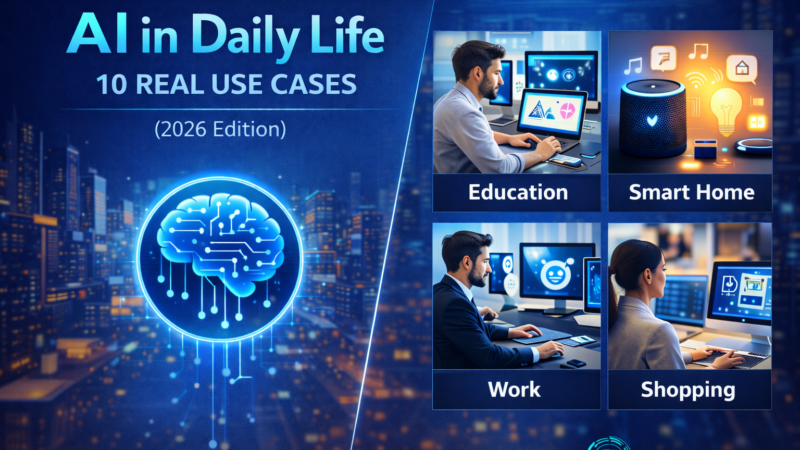
- Education: AI tutors and note-summarizers for personalized learning.
- Healthcare: Early diagnosis through predictive models.
- Marketing: Personalized campaigns using customer data.
- Content Creation: Automated text, image, and video generation.
- Finance: Fraud detection and portfolio management.
Advantages and Challenges
Advantages: speed, accuracy, cost-efficiency and scalability.
Challenges: Data privacy, misinformation, bias in algorithms, dependency on automation.
The Future of AI
In 2026, the focus is on ethical and transparent AI — ensuring systems remain fair, unbiased, and aligned with human values.
The next phase of AI will involve multi-modal intelligence (text, image and sound processing together) and autonomous learning without direct human input.
Final Thoughts
AI is not replacing humans—it’s amplifying human potential.
Understanding how it works helps you use it responsibly and smartly.
TechySpeed’s mission is to make AI understandable, practical, and beneficial for everyone.
FAQ
ML is a subset of AI focused on learning from data.
Not yet—AI follows learned patterns, not consciousness.
Start with free tools like ChatGPT, Google AI Studio, or Coursera’s ML courses.